

Your Order
 FIRST ORDER SPECIAL!
Get 20% OFF on your first order
ORDER NOW
20% OFF FIRST ORDER
FIRST ORDER SPECIAL!
Get 20% OFF on your first order
ORDER NOW
20% OFF FIRST ORDER
Darwin’s Theory of Natural Selection in Retailing: Evolution and Adaptation
Sample Content
Darwin’s Theory of Natural Selection in Retailing
DARWIN’S THEORY OF NATURAL SELECTION IN RETAILING
by Student’s Name
Class/Course/Code
Professor’s Name
University/School
City, State
Date
Word Count - 1681
Darwin’s Theory of Natural Selection in Retailing
Retailing is a dynamic and distinct sector of myriad economies and is a primary conduit for both the production and consumption linkages in the economies (Findlay & Sparks, 2002). Being a dynamic part of management, retailing has a living nature and scope. The dynamism of retailing implies that organisations have to cope with the ever-changing environment (Miller, 1982). As change is the centre point of management, it implies that organisations need to cope with the ever-changing environment (Chakravarthy, 1982). Also, change and evolution are sometimes used interchangeably (Grecu, 2017). In evolutionary terms, change is defined as “a cumulative, recurrent progression of selection and retention of organisational entities” (Van De Ven & Poole, 1995). The evolutionary theory of Charles Darwin (1809 – 1882) on natural selection of living organisms best explains the Evolutionary concept of Life (Grecu, 2017). According to Darwin, life changed gradually with time and living beings also changed accordingly to better fit or adapt to the changed environment. Darwin, through his theory of Natural Selection, propounded that organisms that fit the environment survive and the ones that do not fit, perish (Grecu, 2017). Likewise, Darwin’s theory, the businesses also cope with the changing environment and the ones that adapt to the changed market survive. This paper herein takes a closer look at how Darwin’s theory of natural selection explains the strategic developments of retailing as a business.
Retailing Evolution and the Synthesis Approach
In a long input – output value chain comprising production and distribution of goods to individuals and households, Retailers are at the terminal position. Retail stores present an arena where the revenue is generated and the consumption of the goods begins (core.ac.uk, n.d). Therefore, retailers have an important place in the market as far as revenue generation and goods consumption are concerned. The arrival of departmental stores in the mid-1800s has led to significant changes in five main areas of retailing, namely, technologies, formats, customer types, geography and forms of ownership (Chandler, 1977). The evolution in retailing is widely accepted by the view point of Brown (1987) who gave the ‘synthesis’ approach to the transformative process of retailing. The transformative process has been distilled by ‘Synthesis’ into three main approaches or theories; Environmental, Cyclical and Conflict. Simply put, there are three forces; environmental force and cyclical sequence of conflict in the institutions that have brought out changes in the retail formats (Anitsal and Anitsal, 2011). This retailing evolution comprising three variables has withstood for decades (Anitsal and Anitsal, 2011).
Environmental Theory and Retail Adaptation
The Environmental theory, also called as Ecological theory explains how retail environment plays an important role in the carrying out of retail change. According to this theory, an adaptive behaviour in response to the changing environment is required for one’s survival (Etgar, 2002). The retail environment is constantly changing and so should change a retail institution, in order to remain in harmony with the changing environment. This means, the retail institution should be dynamic alike its environment otherwise it would be at risk of decline or replacement (Markin & Duncan, 1981). This theory of Darwin’s Natural selection in which he proposes the ‘survival of the fittest’ is now being deployed in the retail institutions (Kressens, 2017). For instance, a number of variables together form a retail environment, namely, technology, economy, consumers, competition, political and legal systems (Kressens, 2017). Not everywhere the same variables would form the retailing environment. In some areas, technology like internet and mobile usage may prevail whereas in remote areas it may not prevail. Thus, according to the environment variables, the retailing institutions should adapt otherwise it would be detrimental for the institutions to survive (Kressens, 2017).
Cyclical Theories of Retailing
Another retailing theory, Cyclical model theory, explains how retailers pass through before-known stages or a cycle. Some of the well-known theories within this retailing theory include the ‘Wheel of Retailing’ and the ‘Retail Accordion’ (Anitsal and Anitsal, 2011). The Wheel of Retailing shown in the below figure, is a concept originated by McNair (1958, according to which the new retail institutions start as low price and low status firms. Over time they develop and become bigger firms with bigger facilities and higher operating costs. Finally they evolve into Mature organizations that are high cost and high price firms that have competition with the newly emerges institutions that undergo the same Wheel of retailing (Hollander, 1960). 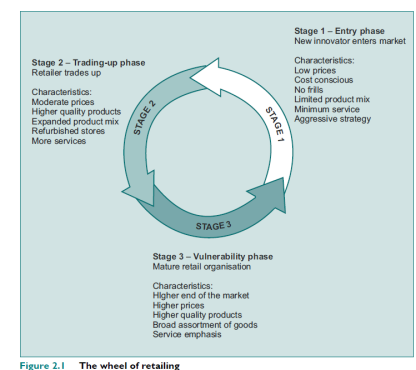
Retail Accordion and Retail Life Cycle
Hollander (1966) also found an accordion pattern in the retail development in which he gave the theory of generalised and specialised stores. This cyclical theory relates retail development to merchandise range. There is a tendency for retail organizations to move from being generalised to specialised and diversified over time. Another theory of Retail Life Cycle is based on the fact that all the retail organisations undergo four phases of development, namely, Innovation, Growth, Maturity and Decline and thus have a finite lifespan. These theories indicate the dynamism involved in the retailing industry and indicate the living nature of the retailing industry.
Conflict Theory and Retail Evolution
Conflict theory is another theory that explains the thesis-antithesis-synthesis theory in which the established retail formats form the thesis, the new ones with opposite formats form antithesis and another new formats formed by antithesis at the time of conflicts form synthesis. The synthesis will then become an established format and will form thesis (Kressens, 2017). All these retailing theories thus represent the dynamic or ever changing nature of the environment and so should change the retailing institution otherwise the retailing institution my not fit the changing environment and may perish. Thus, Darwin’s theory of survival of the fittest justifies the retailing theories.
Digitalisation, Innovation and Retail Survival
McArthur, Weaven & Dant (2015) explain the six primary causes that bring out change in the retailing industry. These include – economic efficiencies, power inequities, patterns operating in nature, environmental influences, innovative behaviour, system’s interdependent parts in co-evolution (McArthur et al., 2015, p.273). In order to beat the traditional retailing, unconventional retailing in the form of digitalization has emerged. Digital retail technology or internet-based e-commerce retailers like Amazon.com, Ebay.com are now giving tough competition to the conventional retailers as the technology is growing at a faster pace in the modern world (Rigby, 2011). Digital retailing is now morphing into omni-channel retailing in which retailers can interact with consumers through all possible channels like social media, websites, physical stores, direct mailing, mobile devices, kiosks, televisions and more (Rigby, 2011). Unless conventional retailers go the unconventional way, it will thus become difficult for them to survive akin Darwin’s theory of natural selection. Thus breakthrough innovation is the key to cope with the ever changing fast-paced environment. If the businesses are to survive, they must adapt to the ongoing changes in the environment or they have to face setbacks that are detrimental to their existence.
Retail Marketing Mix and Adaptation
In order to suit the Market, the Marketing mix in retailing is a concept that cannot be ignored. The Marketing Mix in retailing, as defined by Kotler (1976) is the set of controllable variables that any firm uses to influence the response of its buyers (Davies & Liu, 1995). The famous Ps of Marketing, Product, Price, Promotion and Place, were formulated by Gerome McCarthy (1960). There are three more Ps that contribute in adding to unique customer experience, namely, Physical Evidence, Process and Personnel (Constantinides, 2006). Retail Marketing Mix comprises all the goods or services that a retailer can offer to its customers and the programmed efforts the managers that help the store to adapt according to the Market environment (Azeem and Sharma, 2015). Over the years, the Marketing Mix theories propounded by McCarthy have seen some alterations. For instance, Hansen (1990) proposed nine marketing elements, namely, Location, Assortment, Product, Private Labels, Price, Store layout, Price, Promotion, Customer Service and Customers’ Complaints Management (Azeem and Sharma, 2015). All in all, the Marketing mix as proposed by the authors suggest that the retail market is customer-oriented and has to make alterations according to the main 4Ps; Product, Place, Price and Promotion. This again indicates the dynamic nature of the businesses.
Conclusion: Darwinian Evolution and Retail Survival
Summarizing, Retailing is a primary conduit of production and consumption of goods and the culminating end of the input-output system. Not only does retailing ensure revenue generation but also enables consumption of goods and services. It is thus, a very important element in the revenue generation in economies. As Change and Evolution are at the heart of Management, the retailing industry is dynamic and has a living nature and scope. Akin to the theory of natural selection as propounded by Charles Darwin, the retailing institutions can only survive by changing themselves in the constantly changing environment. Else, they would not be able to survive. Just like the theory of survival of the fittest, the dynamic retailing organisations also have to adapt to the changing environment in their effort to adapt and survive. In purview of the retailing theories like Environmental theory, Cyclical and Conflict theories, change is the only constant thing, that means change is a persistent entity that drives retailers to change and adapt accordingly. With rise of unconventional retailing in the form of digitalization, the e-commerce market has an extra edge over the conventional market. The omnichannel market through its mediums like websites, social media platforms, kiosks, physical as well as digital presence have thus taken over the traditional retail market. In order to survive, the traditional markets should make such Retailing Marketing Mix that could help them adapt to the highly competitive market otherwise it will be difficult for them to persist. The main components of Retail Marketing Mix include 4Ps; Product, Price, Place and Promotion, The three added Ps – Physical Evidence, Process and Personnel have added value to the Marketing Mix and made it more reasonable. Over the years, different authors made changes in the original marketing mix and have made it more useful. All these dynamic traits indicate the significance of ever changing dynamic Retail industry. Thus, akin to a living entity, Darwin’s concept of evolution explains the strategic developments of retailing as a business. To conclude, for organizations to grow and sustain themselves in the competitive world, going ahead with the changing environment and adapting accordingly is must else they would fade and gradually die off.
References
Anitsal, Ismet and Meral Anitsal (2011), “Emergence of Entrepreneurial Retail Forms,” Academy of Entrepreneurship Journal, 17 (2), 1-17.
Azeem, S. & Sharma, RRK. (2015) Elements of the retail marketing mix: a study of different
retail formats in India. Indian Institute of Technology, Kanpur. Available at https://cberuk.com/cdn/conference_proceedings/2015iciee_india11.pdf
Brown, Stephen (1987), “Institutional Change in Retailing: A Review and Synthesis,” European Journal of Marketing, 21 (6), 5–36.
Chandler, Alfred D. (1961), “Recent Developments in American Business Administration and
their Conceptualization,” Business History Review, 35 (Spring), 1–27.
Davies, G. & Liu, H. (1995) The retailer's marketing mix and commercial performance. The International Review of Retail Distribution and Consumer Research. Available at file:///C:/Users/user/Downloads/Theretailersmarketingmixandcommercialperformance%20(1).pdf
Grecu, A. (2017) Retailers in the Era of Digital Darwinism. Aalborg University. Available at https://projekter.aau.dk/projekter/files/260040289/IM_thesis_Alina_Grecu.pdf
Hollander, Stanley (1960), “The Wheel of Retailing,” Journal of Marketing, July, 37–42
Kressens, A. (2017) Innovation in Retailing. Online. Available at https://edepot.wur.nl/430256
Markin, Rom, and Calvin Duncan (1981), “The Transformation of Retailing Institutions: Beyond
the Wheel of Retailing and Life Cycle Theories,” Journal of Macromarketing, Spring,
58–66.
McArthur, Ellen (2005), “Towards a Theory of Retail Evolution: An Australian History of
Retailing in the Early Twentieth Century,” doctoral dissertation, University of
Technology Sydney Australia.
Rigby, D.K. (2011) The Future of Shopping. Harvard Business Review. Available at https://hbr.org/2011/12/the-future-of-shopping
Related Services: Management Assignment Help | Assignment Writing Services | Essay Writing Service