

Your Order
 FIRST ORDER SPECIAL!
Get 20% OFF on your first order
ORDER NOW
20% OFF FIRST ORDER
FIRST ORDER SPECIAL!
Get 20% OFF on your first order
ORDER NOW
20% OFF FIRST ORDER
Nature vs. Nurture: Impact on Human Health and Behavior
Sample Content
Nature Vs Nurture: Their Impact on Human Health and Behavior
Student’s Name
Professor’s Name
Course Number
Date
Referencing Style: MLA
Word Count: 832
Nature Vs Nurture: Their Impact on Human Health and Behavior
The debate on the impact of Nature versus Nurture on the human health and behavior has been one of the oldest issues in psychology (Levitt, 2013). Whereas the term ‘Nature’ implies pre-wiring and the genetic make-up of an individual, ‘Nurture,’ on the other hand refers to the external factors being taken into consideration after conception of a human being (Zaky, 2015). This paper herein takes a closer look at the debate how Nature, Nurture and/or both the factors impact the human health and their psychological well-being. In its first part, the paper will peek into the biological factors impacting the psychology and health of the human being, followed by the impact seen on them by the Environment. The last part will conclude whether one or both of the factors impact the physical and psychological health of an individual.
Nature and Its Impact on an Individual
The human brain, spinal cord and its peripheral branches or simply put, the nervous system along with the endocrine system play a major role in keeping both the physical and psychological health of an individual. The endocrine system as well as the nervous system work in synchrony to the stressful situation. Both the systems work in tandem to communicate with all the internal organs of the body.
The HPA Axis and Psychological Well-Being
There is a Hypothalamic-Pituitary-Adrenal Axis (HPA Axis) that has a significant role to play in the neuroendocrine system to regulate not just stress but to respond to many body processes like the immune system, sexuality, digestion, and energy expenditures (lumencandela, n.d.). The HPA Axis produces cortisol and regulates both the psychological well-being of an individual as the alterations in the levels of the hormone can lead to psychological conditions such as anxiety-disorders, insomnia, bipolar disorder, insomnia, ADHD, Depression, to name a few (lumencandela, n.d.). Therefore, the HPA Axis is a regulatory organ for the psychological well-being of an individual. Thus, biology acts as a very strong factor for the body to respond to the stressful situations that impact both the physical and psychological health of an individual.
Nurture and it Impact on an Individual
When it comes to environmental aspect of an individual’s health, the ‘environmentalists’ or ‘empiricists’ believe that at the time of a human baby’s birth, the mind is a ‘blank slate’ that is gradually filled with their experiences and learning (Zaky, 2015). The social and environment theorists are of the view that the biosocial causes of crime are relatively unimportant as compared to the environmental causes (Levitt, 2013). However, when the conditions of stress arise, such as losing one’s job, the biological process or the sympathetic part of Autonomic nervous system gets directly impacted and in response to stressful situations like ‘fight or flight,’ stimulates the adrenal glands to produce the hormone adrenaline and cortisol (APA, 2018). The released hormones direct the actions of the autonomic nervous system, thereby signal the autonomic nerves to increase the body’s heartbeat, respiration-rate and dilate the blood vessels in the arms and legs, and the digestive system to release glucose in the blood stream to deal with the emergency situation (APA, 2018). The above facts are evident that when a stressful situation arises, the stressful event triggers the biological processes, thereby indicating that both nature (the biological process) and the nurture (the environmental factor of losing one’s job) have a role to play to combat stress.
Combating Stress: An Interaction of Both Nature and Nurture
The classic flight-fright response to stress is an example of both the (Nurture) Stressful event and the (Nature) Natural response of the Autonomic system of the body to combat the stress. In stressful psychological conditions like Post-Traumatic Stress Disorder (PTSD), studies have been done to find an interplay between Nature and Nurture.
Nature-Nurture Interaction in PTSD
Post-Traumatic Stress Disorder or PTSD is a mental disorder characterized by presence of three cluster symptoms, namely, re-experiencing, arousal and, avoidance and numbing (Koenen et al., 2008). The study carried out by Koenen et al. (2008) on the gene-environment interaction suggests that the population with s/s genotype for 5-HTTLPR, who were exposed
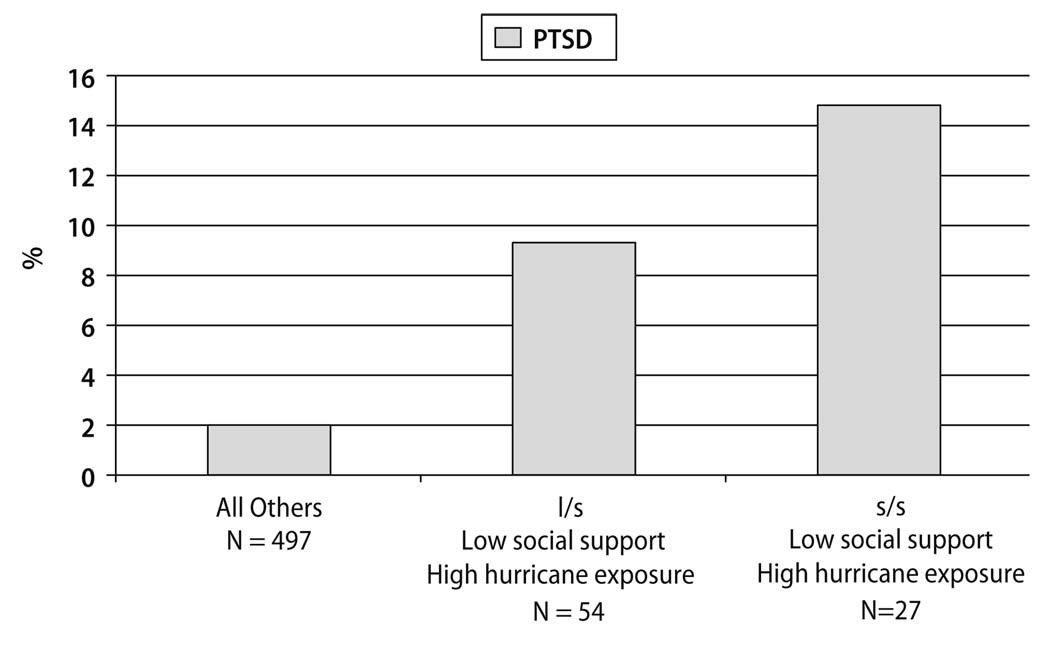
Figure1: Prevalence of post-hurricane PTSD by SLC6A4 genotype, level of social support, and level of hurricane exposure in adults exposed to 2004 Florida Hurricanes. Source: https://www.ncbi.nlm.nih.gov/pmc/articles/PMC2736096/figure/F1/
Gene-Environment Interaction and PTSD Findings
to low social support and had been exposed to hurricane exposure, were most likely to develop PTSD as compared to other groups, as shown above in the Figure 1 (Koenen et al., 2008). Therefore, the evidence of Nature-Nurture (Gene x Environment) interaction suggests that both the factors have an important role to play in determining the health and psychological well-being of an individual.
Conclusion: The Interaction of Nature and Nurture
Summarizing, the impact of Nature-Nurture on the well-being of individuals has always been a topic of debate in psychology. Whereas the Naturists believe that genetic makeup of an individual has the key role in responding to stressful events, environmentalists on the other hand, are of the view that it’s the environment that makes an individual responsive to events. However, studies have shown that both gene-environmental factors interact to make an individual responsive accordingly. Thus, both neuro-endocrine and environmental factors affect the physical and psychological health of an individual.
Works Cited
“Biological Foundations of Psychology.” Lumencandela. n.d. https://courses.lumenlearning.com/boundless-psychology/chapter/the-endocrine-system/
Accessed: 08-08-2021
Koenen, Karestan C., Nugent, Nicole, R., and Amstadter, Ananda, B. Gene-environment interaction in posttraumatic stress disorder. Eur Arch Psychiatry Clin Neurosci, 2008
https://www.ncbi.nlm.nih.gov/pmc/articles/PMC2736096/ Accessed: 08-08-2021
Levitt, Mairi. Perceptions of nature, nurture, and behaviour. Life Sciences, Society and Policy, 2013. https://lsspjournal.biomedcentral.com/articles/10.1186/2195-7819-9-13 Accessed: 08-08-2021
“Stress effects on the body.” American Psychological Association. 2018. https://www.apa.org/topics/stress/body Accessed: 08-08-2021
Zaky, Eman Ahmed. Nature, Nurture, and Human Behavior; an Endless Debate. Journal of Child and Adolescent Behavior. 2015. https://www.omicsonline.org/open-access/nature-nurture-and-human-behavior-an-endless-debate-2375-4494-1000e107.php?aid=62790
Accessed: 08-08-2021
Related Services: Psychology Assignment Help | Nursing Assignment Help | Custom Essay Writing Service